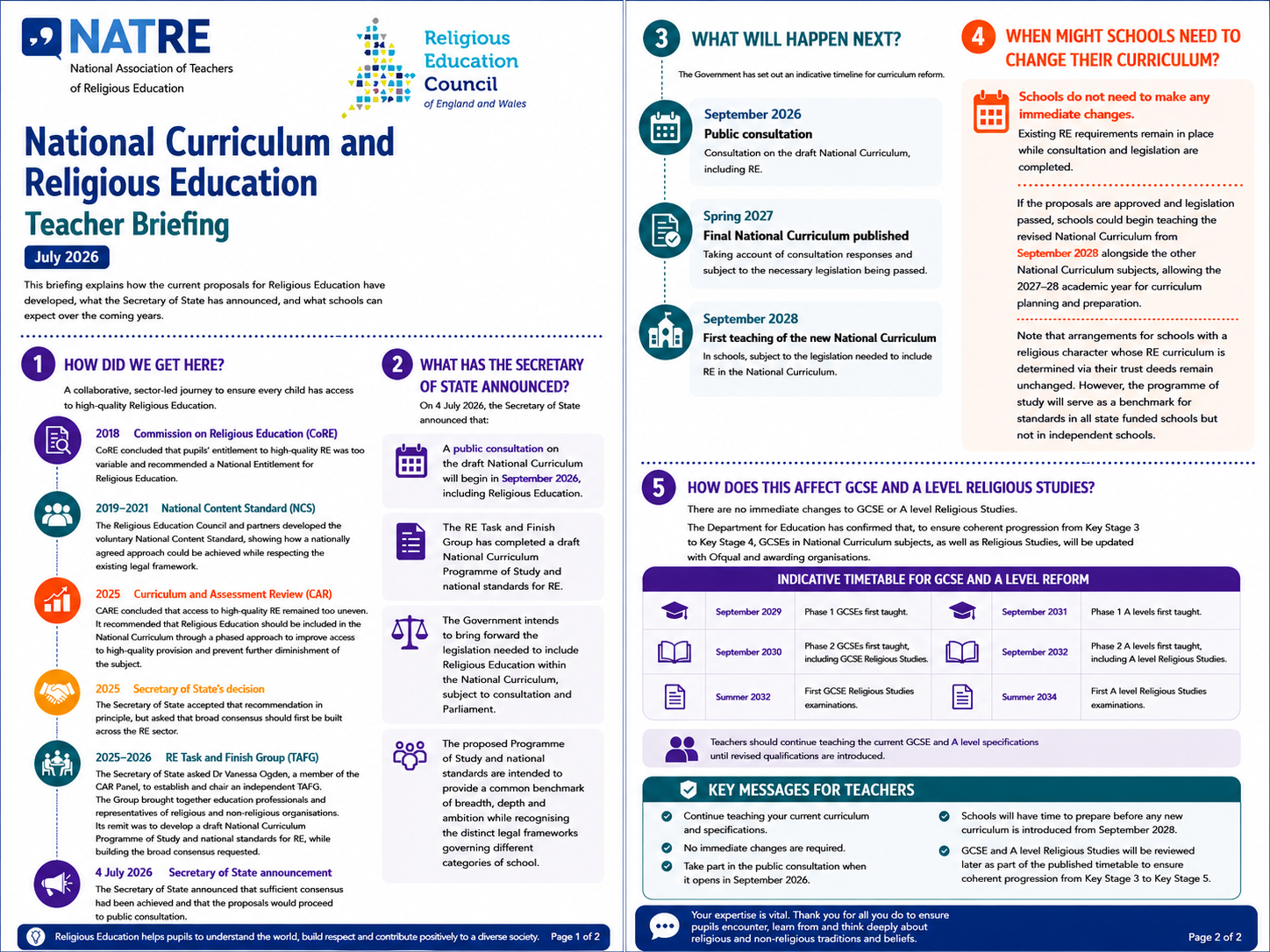
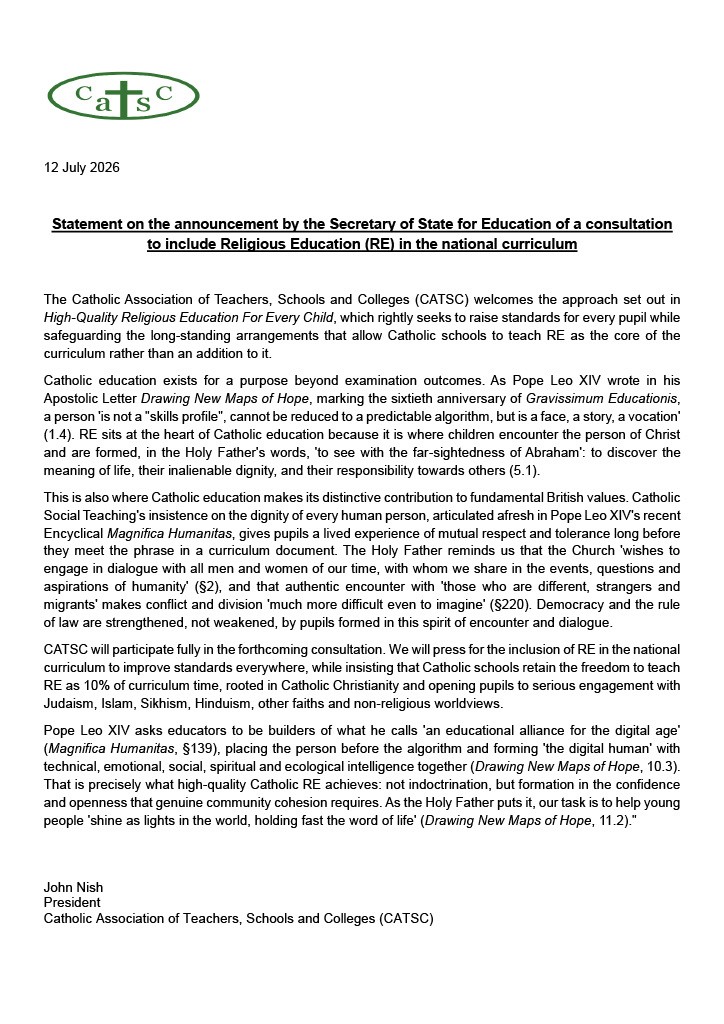
The Secretary of State for Education has announced that there will be a public consultation on future content of the national curriculum, including Religious Education, in September.
Proposals have been drafted by the RE Task and Finish Group, which brought together education professionals alongside representatives of religious and non-religious organisations across England, including the CES, with recommendations made in its report titled High-Quality Religious Education For Every Child.
The proposals enable Catholic schools to continue teaching the RE curriculum as set by the Bishops, with inspection by the Catholic Schools Inspectorate, but within the national curriculum.
Paul Barber, Director of the Catholic Education Service, said: "We welcome the approach outlined in High-Quality Religious Education For Every Child to both include RE in the national curriculum while preserving long-standing arrangements for church schools which make up a third of the state sector.
“The CES will of course participate in the forthcoming consultation in support of the inclusion of RE in the national curriculum, to help improve standards of non-denominational RE.
“RE has long been compulsory in all schools, and in Catholic schools 10% of curriculum time is dedicated to it. This means alongside Catholic Christianity other religions like Judaism, Islam, Sikhism and non-religious world views are given more study time than in most non-denominational schools, contributing to community cohesion.”
Please also see above a briefing from the National Association of Teachers of Religious Education (NATRE) and a statement on the issue from the Catholic Association of Teachers, Schools and Colleges (CATSC).
FAQs:
Q: What is the current position of RE in the curriculum?
A: RE has been compulsory in all schools since 1944 and is part of the basic curriculum alongside the National Curriculum which was introduced in 1989.
Q: How is RE taught in Catholic schools at present?
A: Catholic schools teach the Religious Education Directory, as set by the Bishops, with inspection by the Catholic Schools Inspectorate (CSI). Other denominations have the same freedoms.
Q: How is RE taught in schools without a religious character, at present?
A: In schools without a religious character an RE syllabus is taught as set by the local Agreed Syllabus Conference, with inspection by Ofsted.
Q: What are the proposals regarding RE's future inclusion in the national curriculum?
A: As part of the proposals Catholic schools will continue to teach the Religious Education Directory, as set by the Bishops, with inspection by CSI. In schools without a religious character RE will be taught as part of a national framework while retaining the involvement of local SACREs. In both cases RE will continue to be compulsory and will move from the basic curriculum to the national curriculum.