By Paul Barber, Director of the Catholic Education Service
How do you solve a problem like recruiting 6,500 teachers? By encouraging universities to play a bigger part in the solution.
The National Foundation for Educational Research (NFER) recently found that teacher vacancy rates were at a record high in England. This is in the context of the 2021 Initial Teacher Training (ITT) market review seeing several providers lose their accreditation, albeit many of them continuing with an accredited partner. The fact remains, though, that some universities don’t train teachers any more.
This is due in part to the financial burden and to the resources involved, particularly in securing sufficient school placements. Of the more than 160 universities in the UK, the 24 members of the prestigious Russell Group only train on average 166 teachers each per year (although some do not offer teacher education at all).
In response to recruitment demands over the years partnerships of England’s Catholic universities, diocesan education services, schools and multi-academy trusts (MATs) have developed a ‘growing our own’ approach. These initiatives proactively identify pupils who are interested in teaching, and guide them through work experience, internships, linking them up with Early Career Teachers, and ultimately onto a teacher education course.
It’s not even limited to pupils. At Salesian School, a mixed Catholic comprehensive in Chertsey, in the Diocese of Arundel and Brighton, three parents of former students were among the intake for Xavier Teach Southeast, an accredited ITT provider which is part of the school’s MAT, Xavier Catholic Education Trust.
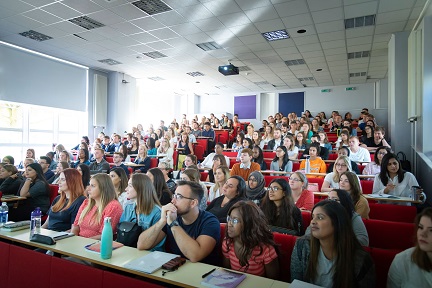
‘Growing our own’ is a relatively low-cost, medium-term approach that can pay dividends. The four Catholic universities — Birmingham Newman; Leeds Trinity; Liverpool Hope; and St Mary’s, Twickenham (trainee teachers pictured at, above) — collectively train around 2,500 teachers every year, or an average of 625 each. This is more than three times the average number trained by institutions in the Russell Group.
Issues with teacher recruitment and training are nothing new, however. A 1980s reorganisation of Higher Education (HE) and Further Education (FE) by the then-government led to teacher training college closures in favour of funding university places, and concerns that some areas would be left with insufficient provision. In 1999 the then Headteacher of Carmel College, Darlington, in the Diocese of Hexham and Newcastle, had enough of complaints about needing more teachers and set up Carmel Teacher Training Partnership, an ITT scheme which has since worked with St Mary’s University.
Other education bodies are undertaking similar activities, most recently Learn to Teach Locally, from Emmaus Catholic Academy Trust and Liverpool Hope University; and the Diocese of Westminster Academy Trust, with St Mary’s. The latter is the thought to be the first ITT scheme specifically geared towards teaching in Catholic schools.
One of the reasons for a more proactive approach to trainee teacher recruitment in our sector is that many Catholic school head teachers will have begun their careers as Religious Education (RE) teachers. Any national shortage of teachers, which would include of course RE teachers, therefore has a corresponding impact on the number of applicants for Catholic school leadership vacancies.
I’m pleased to say that St Mary’s, at which I’m a member of the governing body, was last year rated as Outstanding by Ofsted for its primary and secondary ITT provision. The university works with 600 partner schools, and it’s believed that around half the head teachers and deputy head teachers in Greater London were educated by St Mary’s.
The Department for Education has announced another ITT accreditation round, with eligibility geared towards previously-accredited providers, as well as lead partners. This might see the return of some familiar names from HE.
Our Catholic universities are doing their bit to support schools and ITT providers in training the next generation of teachers. We look forward to a renewed central role for the university sector in delivering teacher education at scale. This would certainly form the foundations of that ambition to recruit 6,500 teachers.
Find out more about training to teach at Birmingham Newman; Leeds Trinity; Liverpool Hope; and St Mary’s universities.